
- Leaks don't stand a chance.
Septic Locating in Gainesville, FL
Know exactly where your tank is before anybody puts a shovel in the ground.
Rather text? Send a photo of the problem to 352-377-9447 and we’ll tell you what it sounds like.
Licensed Florida Plumbing Contractor CFC1430748
Locally owned, out of Hawthorne. Two year parts and labor warranty on work we perform. Part of our Septic Services in Gainesville, FL
Typical distance from the house to the tank
10 to
20
ft
Typical depth of a buried lid
1 to
3
ft
Flat service fee to come out, waived on larger jobs
$
69
Septic tank locating is the process of finding a buried tank, its access lid and the direction of the drain field so work can be done without guessing. In Gainesville and Alachua County, First Choice Plumbing locates tanks using property records, a sewer camera with a transmitter, and metal soil probing. Most tanks sit 10 to 20 feet from the house and 1 to 3 feet deep.
- FL Certified Contractor CFC1430748
- Locally Owned, Out of Hawthorne
- $69 Service Fee to Come Out
- 2 Year Parts and Labor Warranty
- Leaks don't stand a chance.
- The lost tank
Why can't anybody find my septic tank?
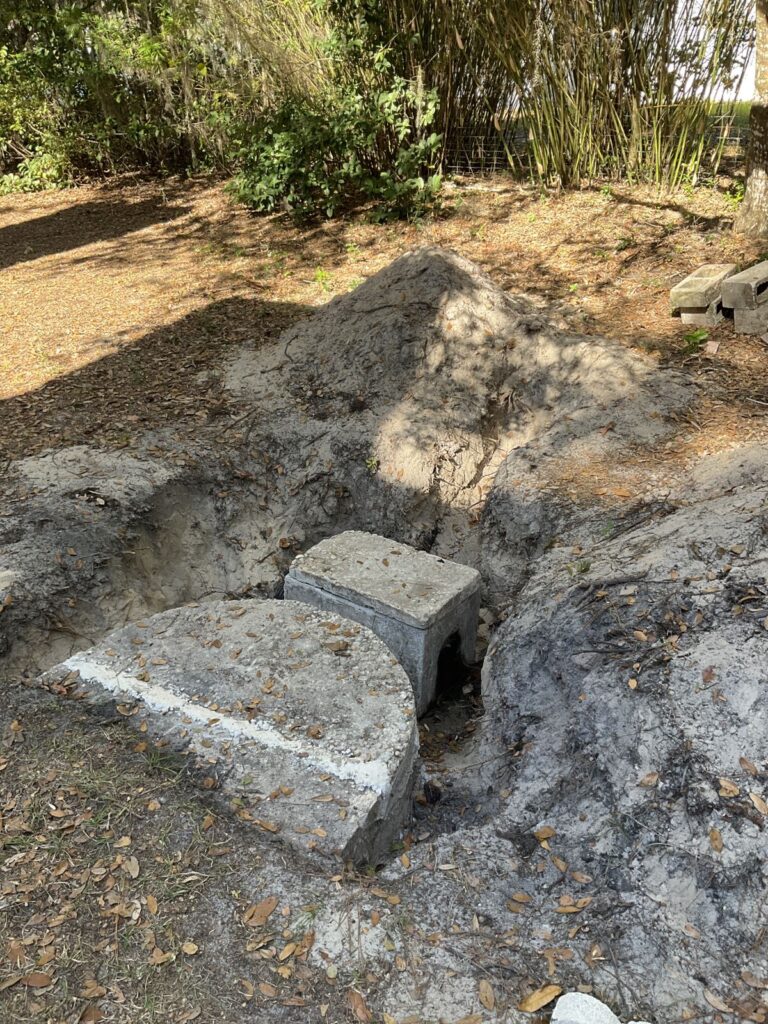
Because for most of the last fifty years, nobody thought you would ever need to. A tank got set, the lid got covered with a foot or two of dirt, sod grew over it, and the paperwork went into a drawer that moved out with the second owner. Around here it gets worse.
- Sandy soil settles and shifts.
- Two decades of mowing, mulching and one energetic previous owner with a bobcat can bury a lid three feet down.
- Add a shed, a pool deck, a garden bed or a driveway extension on top and the tank is now genuinely lost.
Then there is the part nobody says out loud. Standing in your own back yard with a screwdriver, jabbing at the dirt while a pump truck runs the clock, makes a grown adult feel foolish. You own this property. You should not have to guess what is under it.
And the guessing is not free. Every wrong hole is a hole in your lawn. Every hour of hunting is an hour on somebody’s invoice. Meanwhile the actual problem, the slow drains or the soggy patch or the closing date on Friday, is not getting any smaller.
- Try this first
Can I find my septic tank myself before I call anyone?
Often, yes. Try these four things on a Saturday morning before you spend a dollar with us or anybody else.
1. Look at your closing paperwork. The survey, the inspection report or the permit packet may show the system. Half the people who call us already have the answer in a folder in the closet.
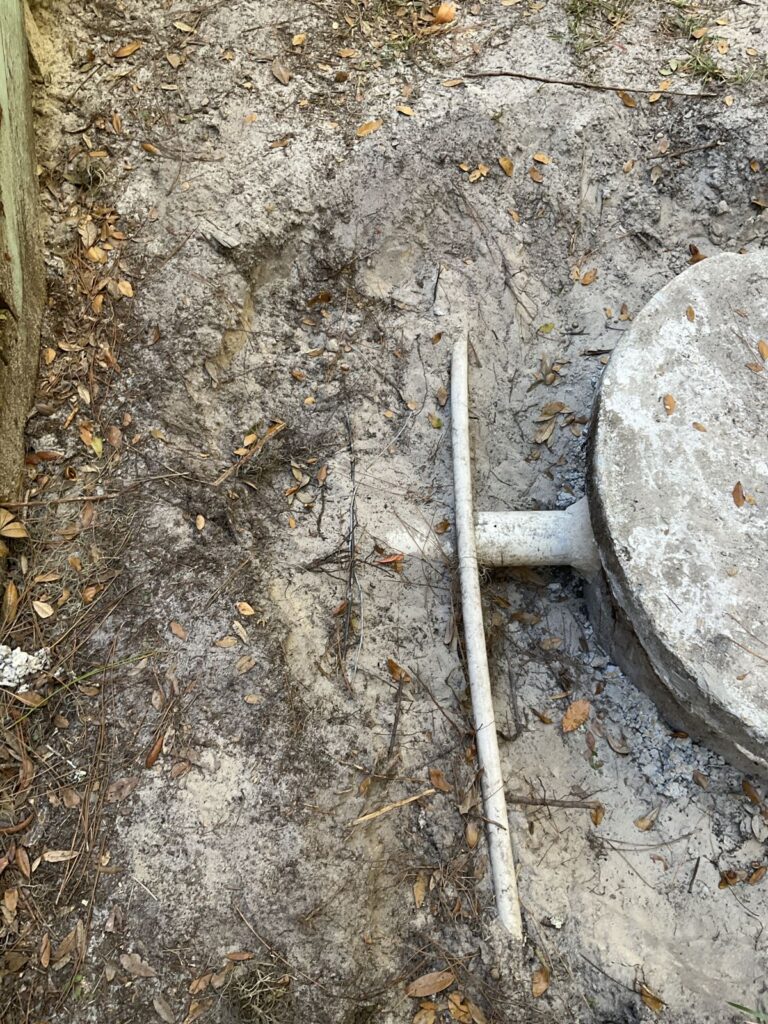
2. Find where the drain line leaves the house. Stand at the wall closest to your bathrooms and look for a white capped pipe in the ground within a few feet of the foundation. The tank is almost always in a straight line out from there, between 10 and 20 feet away.
3. Read the grass. After a dry week, look for a strip that is greener, or a rectangle that stays a shade different from the rest of the yard, or a shallow dip where the soil settled over the lid.
4. Probe gently. A thin steel rod pushed in by hand every foot or so will tap concrete when you hit it. Go slow and stay away from anything that could be a water line, a gas line or an electric run to a shed or a well pump. If you are not certain what is buried there, stop.
Two safety rules that are not negotiable. Never open a septic lid and lean over it. The gases in there can drop a person, and old lids can give way under your weight. And never bring a machine into the search.
Still cannot find it after all that? Contact us
- 10 to 20 feet from the house
- The tank is almost always in a straight line out from where the drain line leaves the house.
- Two safety rules
- Never open a septic lid and lean over it. And never bring a machine into the search.
- Meet the owner
Who is actually coming to your property?
Will Harrod holds the license, CFC1430748, and he still runs the estimates himself. Mike runs the service and drain calls, and Kim answers the phone and dispatches, which is why our trucks are not crossing the county twice in a day. It is a small crew on purpose.
Finding things other people cannot find is the part of this trade Will actually likes. Leak detection is the flagship service for that reason, and locating a buried tank is the same skill pointed at a different problem: work the evidence in order, do not damage the property, and do not stop until you have the answer.
- Will Harrod, owner. Holds the license, CFC1430748, and still runs the estimates himself.
- Mike runs the service and drain calls.
- Kim answers the phone and dispatches.
- How we find it
How do you find a septic tank without digging up the yard?
In order, cheapest first. We do not skip to the expensive step because it is more impressive.
01. Paperwork before shovels.
Every permitted septic system in Florida was drawn on a site plan when it went in. If your property has a permit on file, that drawing usually shows the tank set back a measured distance from a corner of the house. It is not always right, and older rural systems may have no file at all, but it is free and it narrows the search from an acre to a few square feet. We will tell you exactly who to call for the records, and we will call ourselves if you would rather we handle it.
02. Follow the pipe out of the house.
The main drain line leaves the house in one direction and runs to the tank in a straight line, usually with no turns. We find the cleanout or the point where the line exits the slab, and that single fact eliminates three quarters of your yard immediately.
03. Camera and transmitter.
We run our sewer camera down the line from the cleanout with a transmitter in the head, then track it from above ground. That gives us the tank inlet, the depth, and a look at the condition of the pipe on the way there. If the line is broken, bellied or root filled, you find that out on the same trip instead of paying twice.
04. Probe and confirm.
A thin metal soil probe goes in on a grid until it taps the lid. It leaves pencil sized holes in the sod, not a trench. We probe out the corners so you know the footprint, not just one spot, then we mark it, measure it off two fixed points on the house, and write those measurements down for you.
- When you need it
When do you need a septic tank located?
The tank is due to be pumped.
A pump truck cannot pump a lid it cannot reach, and most pumpers charge for the time they spend hunting. Get it located and marked once and every future pump-out is a faster, cheaper visit.
You are selling.
A buyer’s inspector will want the lid uncovered. Finding it the week of closing, in the rain, with two agents watching, is a bad plan.
You just bought.
Learn where the tank and the field are on day one, before you plan a fence, a shed, a pool or a driveway. Building on top of a drain field is expensive to undo.
Drains are slow or the yard is soggy.
Locating is step one of the diagnosis. Once we know where the tank and the field are, we can tell you whether you have a line problem, a full tank or a field that is giving up.
You are replacing the system.
The old tank has to be found before a new one is set, and the old one has to be dealt with properly.
You are connecting to sewer.
When the tank comes out of service it gets emptied, broken up, crushed and buried to code, and that starts with knowing exactly where it is.
Every one of these starts with knowing exactly where the tank is. See everything we do on septic: Septic Services in Gainesville, FL
- What to expect
What happens when you book a locate?
Call or book online.
Kim will ask you a few questions on the phone. Age of the house, whether you have any paperwork, and what is actually going on. Some of those calls end with us telling you where to look yourself.
We come out.
Flat $69 service fee, waived if it rolls into a larger job. We walk the property with you first, because you know your yard better than we do.
We locate and mark.
Records, line, camera, probe, in that order. Flags go in the ground and measurements go on paper.
You get a straight answer.
What we found, what condition the line is in, and what we would do next if it were our house. If the next step is a pump-out, we hand you to our partner, because we do not pump tanks and we are not going to pretend otherwise.
- Compare
The Difference Is in the Details
You leave with the tank marked on the ground and the measurements written down. Do this once and you never pay anyone to hunt for it again.
| What matters | First Choice Plumbing | Typical Septic Contractor |
|---|---|---|
| Where the search starts | Records and the drain line first, because it is free and it is usually right | Straight to probing, on the clock |
| Condition of the line | Camera is already in the pipe, so you get the pipe's condition on the same visit | Locates the tank only, pipe problems found later on a second bill |
| What you keep | Written measurements off two fixed points on the house, plus marked flags | A verbal "it's about over there" |
| Your lawn | Probe holes and hand digging only | Exploratory machine work when the search runs long |
| Who is licensed | Florida Certified Plumbing Contractor CFC1430748, owner still on estimates | License number not published, owner rarely on site |
| Pricing you can see | $69 flat to come out, published, waived on larger jobs | No price anywhere on the website |
| Scope honesty | Tells you plainly what we do not do, and hands off pump-outs to a partner | Says yes to everything, subcontracts quietly |
- Done right
What you have when we drive away
Flags in the ground over the tank, the lid and the line running to it. Measurements taken off two permanent points on your house, written down and handed to you, so the location survives the next rain and the next owner. A straight answer about the condition of the pipe between the house and the tank, because the camera was already down there. And a yard that looks like we were never in it.
If the lid is buried deep and you are tired of digging for it every three years, ask us about setting a riser and lid at grade. Then it is a twist and lift, forever.
- When people guess
What goes wrong when the tank gets found the hard way?
Usually one of four things. Somebody digs a series of holes across the lawn and you spend the next month watering sod. Somebody hits the tank lid with a machine bucket and cracks it, and a $200 problem becomes a $2,000 one. Somebody drives across a drain field that nobody had located and collapses a lateral, which is the single most expensive way to learn where your field was.
Or the quiet one. Nothing gets found, everyone leaves, you pay for the trip anyway, and you are exactly where you started with a closing date three days closer. Locating properly is not the expensive part of septic work. Skipping it is.
- FAQ
Frequently Asked Questions
Start at the house. Find where the main drain line leaves the building, usually on the wall closest to the bathrooms, then look in a straight line out from there. Most tanks sit 10 to 20 feet from the foundation. If you find nothing after that, records research and a camera with a transmitter will settle it in one visit.
Typically the lid sits 1 to 3 feet below the surface, though decades of settling, mowing and added fill can put it deeper. Depth is one of the things we confirm while we are locating, because it changes how much work it takes to open the tank later.
Yes. A camera with a transmitter tracks the line from above ground, and a thin soil probe leaves pencil sized holes in the sod. Hand digging only happens once we know exactly where the lid is, and only if you want it uncovered.
Nationally, professional locating typically runs a few hundred dollars depending on the method and the depth. Our flat $69 service fee gets a licensed plumber to your property, and we quote the locate on site once we can see what we are dealing with. That fee is waived when the work rolls into a larger job.
Sometimes. Permitted systems were drawn on a site plan when they were installed, and those records can often be pulled for your address. Older rural systems may have no file at all. We will tell you exactly where to request the records, or make the request for you.
Almost always. A buyer's inspector will want the lid uncovered, and finding it during the inspection window costs you time you do not have. Locating it early takes the pressure off and gives you a clean answer for the buyer.
A riser is a collar that brings the tank lid up to ground level so it can be opened by hand instead of dug up. If your lid is buried deep and your tank gets pumped every few years, a riser usually pays for itself the second time somebody needs access.
No. We locate, install, replace and abandon systems, and we handle the plumbing side. Pump-outs go through a partner company we trust, and we will get you connected. We would rather tell you that up front than take the job and quietly sub it out.
Licensed CFC1430748
Florida Certified Plumbing Contractor, owner still on estimates.
Locally Owned, Out of Hawthorne
Kim answers the phone and dispatches. It is a small crew on purpose.
$69 Service Fee to Come Out
Flat, published, and waived on larger jobs. Locating is quoted on site.
2 Year Parts and Labor Warranty
On work we perform.
- Where we work
Where do you locate septic tanks?
We are based in Hawthorne, which means the rural side of the county is not a long drive for us, it is home. Most of the septic tanks in this region sit east and south of Gainesville, on the sandy, porous ground that sits over the Floridan Aquifer, and that is exactly where our trucks already are.
Hawthorne | Gainesville | Melrose | Micanopy | Waldo | Keystone Heights | Interlachen | Newberry | High Springs | Archer | Williston | See the full service area
7counties served
22towns with local pages
Hawthornehome base
- Service county
- Town page
- Home base
Select any county or town to open its page.
Don’t see your town? We likely still come out — call 352-377-9447
- Let's talk
Stop guessing where your septic tank is.
One visit, marked on the ground and written down, and you never have to hunt for it again. Call and talk to a real person about your property. If you can find it yourself, we will tell you how. Book online
First Choice Plumbing | 6940 SE 221st St, Hawthorne, FL 32640 | Florida Certified Plumbing Contractor CFC1430748 | Leaks don’t stand a chance.
- Leaks don't stand a chance.
Tell us what's going on and we'll take it from there
You get a real person, a $69 visit, a flat price before we start, and a company that patches what it cuts and answers the phone when you call back. If a smaller fix is the right call, we’ll tell you that too.

First Choice Plumbing is a locally owned, owner led plumbing company working Gainesville, Hawthorne and Greater Alachua County. Leak detection, repipes, water heaters, drains, trenchless lining, well water filtration and septic. We find it, we fix it, we guarantee it.
Florida Certified Plumbing Contractor CFC1430748
Explore
Services
-
First Choice Plumbing
6940 SE 221st St
Hawthorne, FL 32640 - Office Mon to Fri, 8 to 5. Emergency line 24/7.
Copyright © 2026 First Choice Plumbing Inc. All rights reserved. FL Certified Plumbing Contractor CFC1430748.
Proudly Building Legacy with Legacy Sales Engineering