
- Leaks don't stand a chance.
Septic Tank Install & Replacement in Gainesville, FL
Your yard is soft in a spot it never used to be.
Rather text? Send a photo of the problem to 352-377-9447 and we’ll tell you what it sounds like.

Licensed Florida Plumbing Contractor CFC1430748
Locally owned, out of Hawthorne. Every bedroom past the third adds 150 gallons of required tank capacity. Part of our Septic Services in Gainesville, FL
Florida's minimum tank size for a home with up to three bedrooms
900
gal
Nitrogen reduction an enhanced system has to hit in protected basins
65
%+
What it costs to have us come out and look at what you actually have
$
69
First Choice Plumbing installs and replaces septic tanks across Alachua County and the surrounding counties. We handle the permit through the county health department, size the tank to your bedroom count, set it, tie in the drain field, and stay until the inspector signs off. Locally owned, out of Hawthorne. Licensed plumbing contractor CFC1430748. Call 352-377-9447.
- FL Certified Contractor CFC1430748
- Permit pulled for you
- Two year parts and labor warranty
- Locally owned, out of Hawthorne
- Leaks don't stand a chance.
- Repair or replacement
How do I know if my septic tank needs replacing instead of repairing?
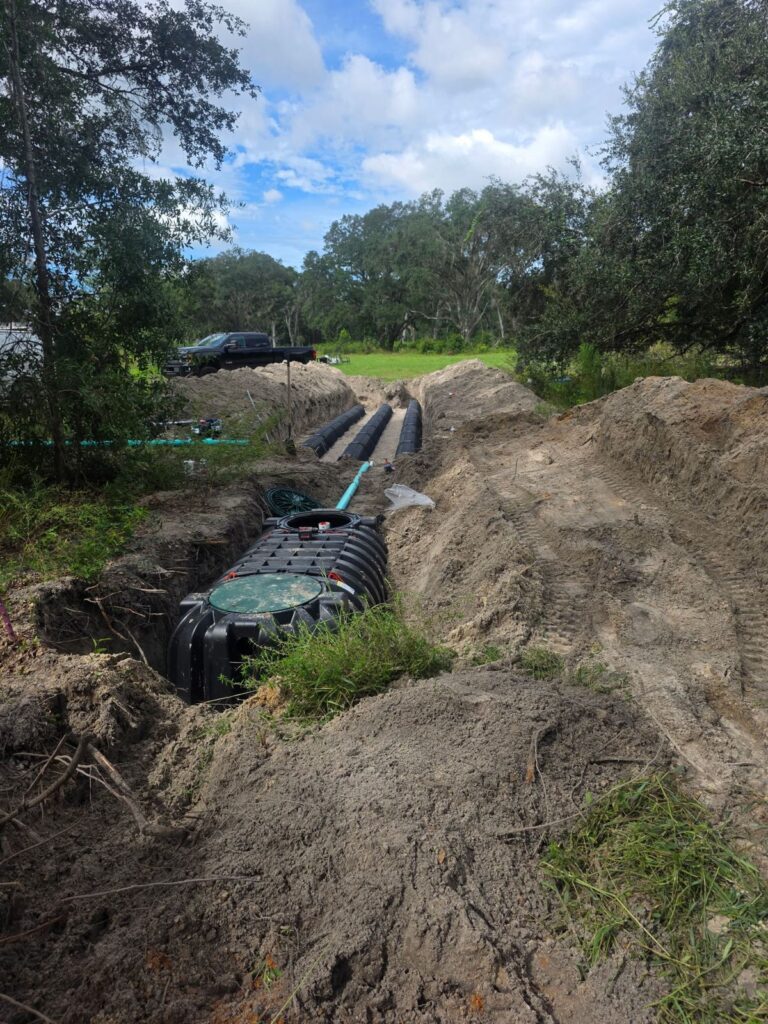
Most of the time, you don’t. That is the honest answer, and it is why so many homeowners end up paying for a new system they did not need, or patching a system that was never going to make it.
Here is the line we use:
- A repair: a cracked baffle, a broken lid, a clogged inlet or a single collapsed line.
- A replacement: a tank that has lost its structure, a steel tank that has rusted through, or a tank that keeps flooding because the drain field underneath it is saturated and finished.
In Florida, a concrete tank usually gives you somewhere in the range of twenty to thirty years, and a drain field often gives out first, closer to fifteen to twenty. Our sandy soil, a high water table and a lot of rain all work against both. Acidic soil eats concrete faster than most people expect. Steel tanks from the sixties and seventies are living on borrowed time and some of them are still out there.
What makes this miserable is not the tank. It is that nobody will tell you plainly which one you have. You get a price and a shrug. You are being asked to spend real money on a decision somebody else made for you in about four minutes.
We will come look, open it up, and tell you which one it is. If it is a repair, we will say so and quote the repair. That is a shorter invoice for us and a better week for you.
- Sizing
What size septic tank does my house need?
Florida sizes tanks off bedrooms, not off how many people live there today.
The state’s minimum for a home with up to three bedrooms is 900 gallons, and every bedroom past the third adds another 150 gallons of required capacity. The daily flow the system is designed around works out to 120 gallons per bedroom.
That is the floor, not the answer. Soil conditions, the water table on your lot, the drain field size and whether the county requires an enhanced system all move the real number. A garage that got converted to a bedroom counts. A future addition counts if you tell us about it now, and it is a lot cheaper to size for it today than to dig twice.
Here is the starting point we work from:
| Bedrooms | Minimum tank capacity | Design flow |
|---|---|---|
| Up to 3 | 900 gallons | Up to 360 gallons per day |
| 4 | 1,050 gallons | 480 gallons per day |
| 5 | 1,200 gallons | 600 gallons per day |
Minimums under Florida’s onsite system standards. Your permitted size can be larger once soil, lot and basin conditions are evaluated.
- 900 gallons
- Florida's minimum tank size for a home with up to three bedrooms.
- 150 gallons
- Added capacity required for every bedroom past the third.
- Licensed for the whole job
Can a licensed plumber install a septic tank in Florida?
Yes. Florida law is unusually clear about this one. Section 489.105(3)(m) of the Florida Statutes says a certified plumbing contractor may install, maintain, repair, alter or extend a septic tank without holding a separate septic tank contractor registration. Every other rule still applies, including Chapter 62-6 of the Florida Administrative Code and the state statutes covering onsite systems, and we follow all of them.
Why it matters to you: the same license that lets us run the drain line out of your house also lets us set the tank it runs into. One company owns the whole path, from the toilet flange to the drain field. Nobody gets to point at the other guy when something does not line up.
Will Harrod is the license holder, CFC1430748, and he is the one who walks your property, looks at the elevations, and prices the job. He is not sending a commissioned closer out to guess at it.
That license is also why the rest of your plumbing does not become somebody else’s problem the moment we start digging. If the line from the house is cracked cast iron, we can line it or replace it. If the well is too close to where the tank has to go, we can talk about that too.
Section 489.105(3)(m), Florida Statutes
A certified plumbing contractor may install, maintain, repair, alter or extend a septic tank without holding a separate septic tank contractor registration.
One company owns the whole path
From the toilet flange to the drain field. Nobody gets to point at the other guy when something does not line up.
The license holder prices your job. Not a salesman.
Will Harrod is the license holder, CFC1430748, and he is the one who walks your property, looks at the elevations, and prices the job.
The rest of your plumbing is covered
If the line from the house is cracked cast iron, we can line it or replace it. If the well is too close to where the tank has to go, we can talk about that too.
- Scope, honestly
What we handle, and what we hand to somebody else
New construction
We do this work ourselves: new septic tank installation on new construction.
Tank replacement
We do this work ourselves: replacing a failed or undersized tank.
Drain fields
We do this work ourselves: drain field installation and replacement.
Abandonment and decommission
We do this work ourselves: abandonment and decommission of an old system when you tie into city service.
House to tank plumbing
We do this work ourselves: the plumbing between the house and the tank.
We hand these off, on purpose: Pump-outs. We work with a local partner who runs the trucks and does it right, and we will get you their number. Septic pump-out Septic inspections. We are not certified for those yet, and we are not going to pretend otherwise. Septic inspection Tile, paint and general contracting. We are plumbers.
Sending you somewhere else costs us a job today. It is still the right call, and it is the reason people call us back.
- What to expect
How the install actually goes
We come look. $69.
We find the existing tank and field, open the lids, and see what you really have. If we cannot find the tank, we locate it. Septic locating You get a straight answer that day on repair versus replacement, and a written price, not a range shouted over a shoulder.
We handle the permit and the parcel check.
We pull the permit through the county health department, confirm which basin your property sits in, confirm whether an enhanced system is required, and set the tank size off your bedroom count and the site conditions. You approve the final number before anything is ordered.
We set it, tie it in, and stay for the inspection.
Excavation, tank set, inlet and outlet tied in, drain field connected or replaced if it needs it. Drain field install and replacement We do not cover it until the inspector signs off, and we grade the yard back before we leave.

- Done right
What done right looks like
A permit on file with the county and a passed inspection you can hand to a buyer, a lender or an insurance adjuster years from now.
A tank sized for your house instead of for whoever lived there in 1978, set level, with risers you can actually get a lid off of when it is time for a pump-out.
- A drain field that is either brand new or verified good, tied in properly, taking water the way it is supposed to.
- A yard that is graded back and looks like a yard. We do not leave a sand pile and a set of ruts for you to sort out on a Saturday.
- And a two year parts and labor warranty on our work, with the manufacturer warranty on top of it.
- Compare
The Difference Is in the Details
None of that is exotic. It is just what happens when the person who signs the permit is also the person who has to look at you at the end of the job.
| What you are comparing | First Choice Plumbing | Typical septic outfit |
|---|---|---|
| Who prices your job | The licensed contractor, on site, walking your property | A salesperson working from a photo and a phone call |
| Repair versus replacement | We open it up and tell you which one it is, even when the answer is the cheaper one | Replacement quoted by default |
| Basin and enhanced system check | Parcel checked before you sign, so the price reflects the rule you actually fall under | Found out at permit review, after the deposit |
| Permit and inspection | We pull it and we do not backfill until it passes | Homeowner handed the paperwork |
| The plumbing between house and tank | Same license covers it, so a bad line gets fixed instead of blamed | Out of scope, call a plumber |
| The yard afterward | Graded back before we leave | Spoil pile and ruts |
| Warranty | Two year parts and labor, manufacturer warranty on top | Varies, often one year or none stated |
| Who answers when something is wrong | Kim answers the phone, Will owns the outcome | A dispatch queue |
- Permits and enhanced systems
Do I need a permit to install or replace a septic tank in Alachua County?
Yes, and it is not a formality. In Alachua County, onsite septic permitting and inspection still run through the county health department’s environmental health office. The system has to be permitted before it goes in and inspected before it gets covered up and used. We handle that paperwork as part of the job, and we do not backfill until an inspector has looked at it.
There is a second layer here that a lot of people find out about too late. Alachua County sits inside springs protection areas tied to the Santa Fe River and the Gainesville area. Inside those zones, a new system can be required to be an enhanced nutrient reducing system, built to cut nitrogen by sixty five percent or more. That requirement turns on where your parcel sits and, in some basins, on how big your lot is. A one acre lot in the wrong basin lands in a different rule than a five acre lot next door.
What that means practically: your neighbor’s quote from four years ago is not your quote. The rule may have changed and your parcel may be classified differently than theirs.
So we check the parcel first. We tell you which basin you are in, whether an enhanced system is required, and what that does to the price before you sign anything. If the county has a rebate program running that you qualify for, we will point you at it, because that is your money and not ours.
Enhanced systems in plain English. An enhanced nutrient reducing system does more treatment before the water reaches the ground, so less nitrogen ends up in the aquifer that feeds the springs. It costs more up front. In the protected basins it is not optional.
- If you wait
What waiting usually costs
A failing tank does not stay a tank problem. Water that should be leaving the tank clear starts pushing solids into the drain field, and a drain field that takes solids is a drain field on a countdown. That is how a tank job turns into a tank and field job, which is a very different invoice.
Waiting also narrows your options. A system that is actively failing gets handled on the county’s timeline, not yours. If you are trying to sell the house or close on a loan, a failed system stops the whole thing cold.
And if the rules for your basin tighten while you sit on it, the system you could have installed last year may not be the system you are allowed to install next year.
Getting it looked at costs $69. Guessing costs a lot more than that.
- FAQ
Septic tank installation questions we get every week
A concrete tank in Florida generally runs twenty to thirty years, and the drain field usually gives out sooner, often around fifteen to twenty. Sandy soil, a high water table and acidic ground all shorten the odds. Steel tanks fail earlier than that and many of the ones still in the ground here are well past their time.
Yes. The replacement has to be permitted through the county health department's environmental health office and inspected before it is covered and put into use. We pull the permit as part of the job and we do not backfill until it passes inspection.
It is a system built to remove significantly more nitrogen before the water reaches the ground, at least sixty five percent more. Whether you need one depends on which springs protection basin your parcel sits in and, in some basins, how large your lot is. We check your parcel before we quote so the price reflects your actual requirement.
Florida's minimum for up to three bedrooms is a 900 gallon tank, with 150 gallons added for each bedroom beyond that. Soil, lot conditions and the drain field can push the permitted size higher. Converted garages and finished bonus rooms often count as bedrooms, so tell us about them.
It depends on tank size, whether the drain field has to be replaced, site access, and whether an enhanced system is required for your basin. That last one moves the number the most. We come out for $69, look at what you have, and give you a written price instead of a range. Financing is available. Plumbing financing
Most straightforward tank replacements are a one to two day job once the permit is in hand. If the drain field is being replaced too, plan on longer. You can usually stay in the house, but there will be a stretch where you cannot run water, and we will tell you exactly when that is before we start.
No. We install, replace, locate and abandon systems, but we do not run pump trucks. We work with a local partner who does pump-outs and we will get you their number. Same answer on inspections, we are not certified for those yet and we will tell you who is.
Licensed CFC1430748
Will Harrod is the licensed plumbing contractor on the paperwork, not a salesman with a tablet.
Permit pulled for you
Permitted through the county health department and inspected before it is covered. We do not backfill until it passes.
Two year parts and labor warranty
On our work, with the manufacturer warranty on top of it.
Locally owned, out of Hawthorne
Kim answers the phone, Will owns the outcome.
- Where we work
Where we install septic tanks
We are based in Hawthorne, which means the rural east side of the county is not a long drive for us, it is home. Most septic work in this area sits out where the lots are big and the water comes from a well.
We install and replace septic tanks in Hawthorne, Gainesville, Melrose, Interlachen, Keystone Heights, Micanopy, Waldo, Windsor, Archer, Newberry, High Springs, Alachua, and the surrounding rural areas of Alachua, Putnam, Bradford, Clay, Levy and Marion counties.
If you are on a well as well as a septic system, ask us about your water while we are out. Well water filtration
7counties served
22towns with local pages
Hawthornehome base
- Service county
- Town page
- Home base
Select any county or town to open its page.
Don’t see your town? We likely still come out — call 352-377-9447
- Let's talk
Find out what you are actually dealing with.
$69 gets the licensed contractor out to your property to open it up, check your parcel, and tell you plainly whether you are looking at a repair or a new tank. No guessing, no pressure, and a written price either way. Book an estimate online
First Choice Plumbing. Licensed Florida plumbing contractor CFC1430748. Locally owned, out of Hawthorne. Leaks don’t stand a chance.
- Leaks don't stand a chance.
Tell us what's going on and we'll take it from there
You get a real person, a $69 visit, a flat price before we start, and a company that patches what it cuts and answers the phone when you call back. If a smaller fix is the right call, we’ll tell you that too.

First Choice Plumbing is a locally owned, owner led plumbing company working Gainesville, Hawthorne and Greater Alachua County. Leak detection, repipes, water heaters, drains, trenchless lining, well water filtration and septic. We find it, we fix it, we guarantee it.
Florida Certified Plumbing Contractor CFC1430748
Explore
Services
-
First Choice Plumbing
6940 SE 221st St
Hawthorne, FL 32640 - Office Mon to Fri, 8 to 5. Emergency line 24/7.
Copyright © 2026 First Choice Plumbing Inc. All rights reserved. FL Certified Plumbing Contractor CFC1430748.
Proudly Building Legacy with Legacy Sales Engineering