
- Leaks don't stand a chance.
Water Testing in Gainesville, FL
Free water testing so you fix the real problem, not a sales pitch.
Rather text? Send a photo of the problem to 352-377-9447 and we’ll tell you what it sounds like.
Licensed Florida Plumbing Contractor CFC1430748
Locally owned, out of Hawthorne. Free water testing. 2 year parts and labor warranty. We answer at 2 a.m.
GRU city water hardness, about 140 mg/L as calcium carbonate. Moderately hard.
8.
2
gpg
The EPA secondary standard for iron. Above this you start seeing stains.
0.
3
ppm
What our in-home water test costs you. No obligation, no equipment pitch.
$
0
Water testing in Gainesville, FL tells you what is actually in your water before you spend a dollar fixing it. First Choice Plumbing tests free at your kitchen sink, usually in about twenty minutes, checking hardness, iron, hydrogen sulfide, pH and total dissolved solids. You get the numbers, an honest read, and no equipment recommendation unless the numbers call for one. Call (352) 377-9447.
- Why your water is doing that
Why does my water smell, stain, or leave spots?
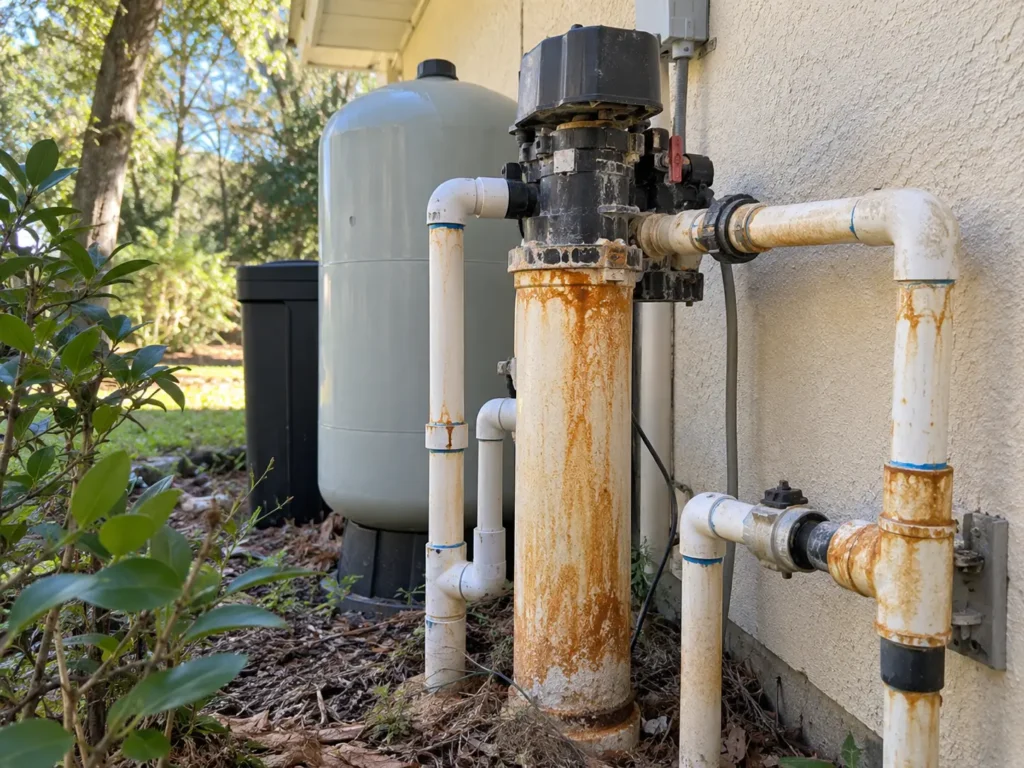
Around here it usually comes down to what the ground gives you. Our water comes out of the Floridan Aquifer, and the aquifer runs through porous limestone. That limestone loads the water up with calcium and magnesium, which is hardness. In rural Alachua and Marion county wells it also brings iron, hydrogen sulfide, and sometimes nitrates from farm and septic activity nearby.
Each one leaves a different fingerprint.
- Hardness shows up as white crust on the faucet aerator, a film in the shower, soap that won't lather, and a water heater that dies years early.
- Iron shows up as orange or reddish staining in toilets, tubs and laundry.
- Hydrogen sulfide is the rotten egg smell, and it is usually worse on the hot side than the cold.
- Nitrates and bacteria show up as nothing at all, which is exactly why they get tested and not guessed at.
Here is the part nobody likes: three different problems can look almost the same from your side of the faucet, and they take three different fixes. Guess wrong and you buy a softener for an iron problem, or a filter for a water heater problem, and you’re out real money with the smell still there. A test costs you twenty minutes. Guessing costs a lot more.
- What we test for
What does a water test actually check for?
Our in-home test is the practical one. It reads the things that decide what equipment you need, or whether you need any at all. It takes about twenty minutes at your kitchen sink and you get the results while we’re standing there, not in an email three days later. Here is what we read and what each number means for your house.
| What we test | Measured in | What we're looking for | What it does to your house |
|---|---|---|---|
| Hardness | Grains per gallon (gpg) | Under 3 is soft. 3 to 7 is moderate. 7 to 10 is hard. Over 10 is very hard. | Scale in the water heater and fixtures, film in the shower, soap that won't lather, appliances that quit early. |
| Iron | Parts per million (ppm) | Anything over 0.3 ppm stains. We also check whether it is dissolved or already rusted, because that changes the fix. | Orange and reddish staining in toilets, tubs, sinks and laundry. Metallic taste. |
| Hydrogen sulfide | Smell and ppm | Whether the rotten egg smell is on the cold side, the hot side, or both. | The smell itself, tarnished silverware, and corrosion on copper over time. |
| pH | 0 to 14 | Low pH is aggressive water. High pH pushes scale. GRU water runs high, around 8.6. | Pinholes and blue-green staining on the low side. Crusty scale on the high side. |
| Total dissolved solids | ppm | The overall mineral load. Useful as a sanity check against the other readings. | Flat or salty taste, spotting on glassware, faster wear on anything that heats water. |
| Chlorine | ppm | On city water only. Tells us whether taste and smell complaints are treatment related. | Pool taste and smell, dry skin, and a shorter life on rubber seals and gaskets. |
Those six readings tell us almost everything about what belongs in your house. Hardness points at a softener. Water softeners Iron and hydrogen sulfide point at an air injection system that works without chlorine. Iron and sulfur removal A mix of both usually points at a full well train. Well water filtration
- Lab testing, plainly
Where can I get my well water lab tested in Alachua County?
We’ll say this plainly, even though it doesn’t sell us anything. If you want bacteria and nitrate results, the Florida Department of Health in Alachua County runs a microbiology water lab and it is the right place to go. You pick up their sample bottle, collect the sample the way they tell you to, and drop it back off. County health department testing typically runs about twenty to thirty dollars a sample statewide, and in a lot of counties they’ll come pull the sample for you for a small additional fee.
Here’s the simple way to think about it:
1. Health department lab.
Bacteria and nitrate. This is a safety question, and it belongs with a certified lab. Once a year, minimum, on any private well.
2. Our in-home test.
Hardness, iron, hydrogen sulfide, pH and total dissolved solids. This is an equipment question, and it’s free.
3. A full panel from a private environmental lab.
Worth it when you’re buying the property, when a neighbor’s well came back bad, or when you’re near old agricultural or industrial ground.
Do both of the first two. They answer different questions, and neither one replaces the other. If your lab results come back with something we can’t treat, we’ll tell you that too.
- What happens after the test
How does a water test with First Choice work?
Tell us what you're seeing.
Call, text or book online and describe it in your own words. Rotten eggs in the morning. Orange in the toilet. White crust on everything. That description tells us a lot before we ever get there.
We test at your sink and hand you the numbers.
About twenty minutes. Hardness, iron, hydrogen sulfide, pH and total dissolved solids, read in front of you. We check the hot side and the cold side separately, because that difference is often the whole answer.
You get a straight recommendation, or none at all.
If your water is fine, we say so and we leave. If it isn’t, you get one written recommendation sized to your actual readings and your actual household, with what it fixes and what it won’t. No pressure and no expiring discount.
Not ready yet? Read how well water filtration works first. Well water filtration
- Meet the owner
Who's actually coming to test your water?
First Choice Plumbing is a locally owned shop out of Hawthorne.
- Will Harrod is the owner and the license holder, Florida Certified Plumbing Contractor CFC1430748. He still runs the estimates himself.
- Big Mike runs the service calls and has seen most of the drains and well systems in this county.
- Kim answers the phone and does the dispatching, and she batches jobs by area so nobody's driving back and forth across the county all day.
That matters on a water test more than you’d think. The person reading your numbers is the same crew that repipes houses, changes out water heaters and chases leaks for a living. So when the reading says hardness and the symptom says water heater, we can tell the difference and say so.
- Plumber vs. sales call
The difference is in the details
Free test, no obligation, and an honest answer even when the honest answer is that you don’t need us.
| What matters | First Choice Plumbing | Typical Water Treatment Sales Call |
|---|---|---|
| Who runs the test | A licensed Florida plumbing contractor's technician who also repairs the pipes and water heater the water runs through. | A commissioned sales rep whose only product is equipment. |
| What "free" means | Free, and you can send us home with a thank you. No obligation attached. | Free entry to a two hour in-home presentation. |
| Can they say "you don't need anything" | Yes, and we do. Some houses test clean and we tell them so. | Rarely. The visit is the sales process. |
| Hot side vs cold side | Tested separately, because a smell on the hot side alone usually means the water heater, not the water. | Usually one sample from one tap. |
| Bacteria and nitrate | We point you to the county health department lab, because that is where it belongs. | Often skipped, because it does not sell equipment. |
| Who installs it if you buy | Our own licensed crew, permitted where required, with a 2 year parts and labor warranty. | A subcontracted installer you meet on install day. |
| Pricing posture | One written recommendation, priced upfront, good whether you sign today or in March. | A "today only" number that drops the longer you say no. |
| Who you call when something goes wrong | The same local shop, at the same number we've had since we started. We answer at 2 a.m. | A regional service line. |
- City water vs. well water
Do I need a water test if I'm on city water?
If you're on GRU or another city system
Your water is already treated and tested constantly, and GRU publishes the results every year. What that report can’t tell you is what happens between the plant and your faucet. GRU’s own guidance says a rotten egg smell in a city home usually traces back to household plumbing, a dirty garbage disposal, or the water heater, not the supply.
So on city water we’re mostly answering two questions. Is the hardness high enough to be eating your water heater and your fixtures, at roughly 8 grains per gallon in the Gainesville system. And if there’s a smell, is it coming from the hot side only, which usually means the water heater and the anode rod rather than the water itself. That second one saves people a lot of money, because a smell that only shows up hot is a water heater conversation, not a filtration one. Water heater repair
If you're on a private well
Nobody is testing your water but you. Private wells aren’t regulated, so there’s no annual report and no utility on the hook. The Florida Department of Health recommends testing a private well at least once a year for bacteria and nitrate, and more often if anything about the taste, smell or color changes, after flooding, or after any work is done on the well.
Our in-home test covers the nuisance side, which is hardness, iron, sulfide, pH and total dissolved solids. That’s what decides your equipment. For bacteria and nitrate you want a certified lab, and we’ll tell you exactly where to go for that.
- Done right
What changes when you know your numbers
You stop guessing. You know whether that smell is the well or the water heater, and you fix the one that’s actually broken. You know whether the softener you were quoted is sized for your hardness or somebody’s standard package. You know your bacteria and nitrate came back clean, or you know they didn’t and you did something about it before anybody got sick.
And the small stuff quietly goes away. The toilet stays white. Glasses come out of the dishwasher clear. The shower feels different. Your water heater gets to live out its actual warranty instead of scaling itself to death six years early. That’s what a twenty minute test buys you.
- The kit on your doorknob
Are those free water tests left on your door real?
You’ve probably seen them. A little bag or a card hung on the doorknob, or a bottle left in the driveway, offering a free community water test. Local reporting in Gainesville has looked into these before and found that a lot of them are marketing, not science. The test is real enough. What it’s built to do is produce a number scary enough to sell you equipment on the spot.
A few honest tells. If the person testing your water can’t tell you what the reading means without immediately quoting a price, that’s a sales call. If the number goes up dramatically when they run it a second time with a different reagent, that’s theater. If there’s a discount that expires when they walk out the door, walk them out the door.
Our test is free because knowing what’s in your water shouldn’t cost anything, and because we’d rather sell the right thing to the right house than the same thing to every house. Sometimes the reading comes back fine and we tell you to keep your money. Sometimes the smell turns out to be your water heater and the fix is a couple hundred dollars instead of a couple thousand. That happens more than you’d think.
- FAQ
Water testing questions we get asked
Our in-home test is free, with no obligation and no equipment pitch attached. If you want bacteria and nitrate run by a certified lab, county health department testing generally runs about twenty to thirty dollars a sample, and a full private lab panel costs more depending on how many contaminants you include.
At least once a year for bacteria and nitrate, which is what the Florida Department of Health recommends for private wells. Test again any time the taste, smell or color changes, after flooding, after any work is done on the well or the pump, and before you buy a property with a well on it.
About twenty minutes at your kitchen sink. You get the readings while we're standing there, not in an email a few days later. We'll also pull a hot side sample if there's a smell, because that comparison often answers the whole question.
Not by itself. Our test reads the nuisance side, meaning hardness, iron, sulfide, pH and dissolved solids, which is what decides your equipment. Safety questions like bacteria, nitrate and heavy metals need a certified lab, and we'll point you to the Florida Department of Health in Alachua County for that.
That usually points at your water heater rather than your water. The magnesium anode rod inside the tank can react with the water and produce that rotten egg smell. Flushing the heater and switching to an aluminum anode rod often fixes it, which is a far smaller job than a filtration system. Water heater repair
Maybe, and it depends on what you care about. Gainesville water runs around 8 grains per gallon, which is on the hard side of moderate. That's enough to scale a water heater and spot your glassware, but it isn't a health issue. Get the number first, then decide. Water softeners
Yes, and it's a smart time to do it. We'll run the in-home test and tell you what equipment the house would need, and we'll tell you to get bacteria and nitrate run by a lab before you close. If the property is on septic as well, we can walk that side of it with you too. Septic services
Licensed Florida Plumbing Contractor
CFC1430748. Will Harrod is the owner and the license holder, and he still runs the estimates himself.
Free water testing
About twenty minutes at your kitchen sink. No obligation, no equipment pitch.
2 year parts and labor warranty
On anything we install, with the manufacturer warranty on top.
We answer at 2 a.m.
The same local shop, at the same number we've had since we started.
- Where we test
Where do you test water?
We’re based in Hawthorne and we work across North Central Florida. The rural east and south side of the county is where the wells are, and it’s the part of the map most plumbers skip, so it’s the part we know best. If you’re not sure whether you’re in range, call and ask. All service areas
Alachua County: Gainesville | Hawthorne | Alachua | High Springs | Newberry | Archer | Micanopy | Waldo
Marion, Putnam, Clay, Bradford, Union and Levy: Citra | McIntosh | Fort McCoy | Interlachen | Melrose | Keystone Heights | Starke | Williston
7counties served
22towns with local pages
Hawthornehome base
- Service county
- Town page
- Home base
Select any county or town to open its page.
Don’t see your town? We likely still come out — call 352-377-9447
- It's free
Find out what's actually in your water. It's free.
Twenty minutes at your kitchen sink, real numbers in your hand, and a straight answer about whether you need anything at all. Licensed, locally owned, and based right here in Hawthorne. Get your free water test
Leaks don’t stand a chance.
- Leaks don't stand a chance.
Tell us what's going on and we'll take it from there
You get a real person, a $69 visit, a flat price before we start, and a company that patches what it cuts and answers the phone when you call back. If a smaller fix is the right call, we’ll tell you that too.

First Choice Plumbing is a locally owned, owner led plumbing company working Gainesville, Hawthorne and Greater Alachua County. Leak detection, repipes, water heaters, drains, trenchless lining, well water filtration and septic. We find it, we fix it, we guarantee it.
Florida Certified Plumbing Contractor CFC1430748
Explore
Services
-
First Choice Plumbing
6940 SE 221st St
Hawthorne, FL 32640 - Office Mon to Fri, 8 to 5. Emergency line 24/7.
Copyright © 2026 First Choice Plumbing Inc. All rights reserved. FL Certified Plumbing Contractor CFC1430748.
Proudly Building Legacy with Legacy Sales Engineering