
- Leaks don't stand a chance.
Tankless Water Heater Flush & Descaling in Gainesville, FL
Your tankless heater is the one appliance in the house that asks for something back.
Rather text? Send a photo of the problem to 352-377-9447 and we’ll tell you what it sounds like.

8.2 grains per gallon
Hardness in GRU water, which is why annual flushing is the standard here. Licensed Florida Plumbing Contractor CFC1430748.
Flushes most Alachua County homes need, matching the manufacturer maintenance terms
1
a Year
Years a maintained tankless unit should run, against under ten when scale is left alone
15
to 20 yrs
Standard residential flush and descaling with working isolation valves
About $
350
First Choice Plumbing flushes and descales tankless water heaters across Gainesville, Hawthorne and Alachua County. A licensed plumber circulates food grade vinegar through the heat exchanger, cleans the inlet filter screen, checks the venting and condensate trap, and leaves you a dated service record. Most units here need it once a year. It runs about $350. Call or text 352-377-9447.
- Licensed CFC1430748
- Locally owned, out of Hawthorne
- Vinegar flush, no harsh chemicals
- Service record for your warranty file
- How to tell yours is overdue
How do you know your tankless heater is overdue for a flush?
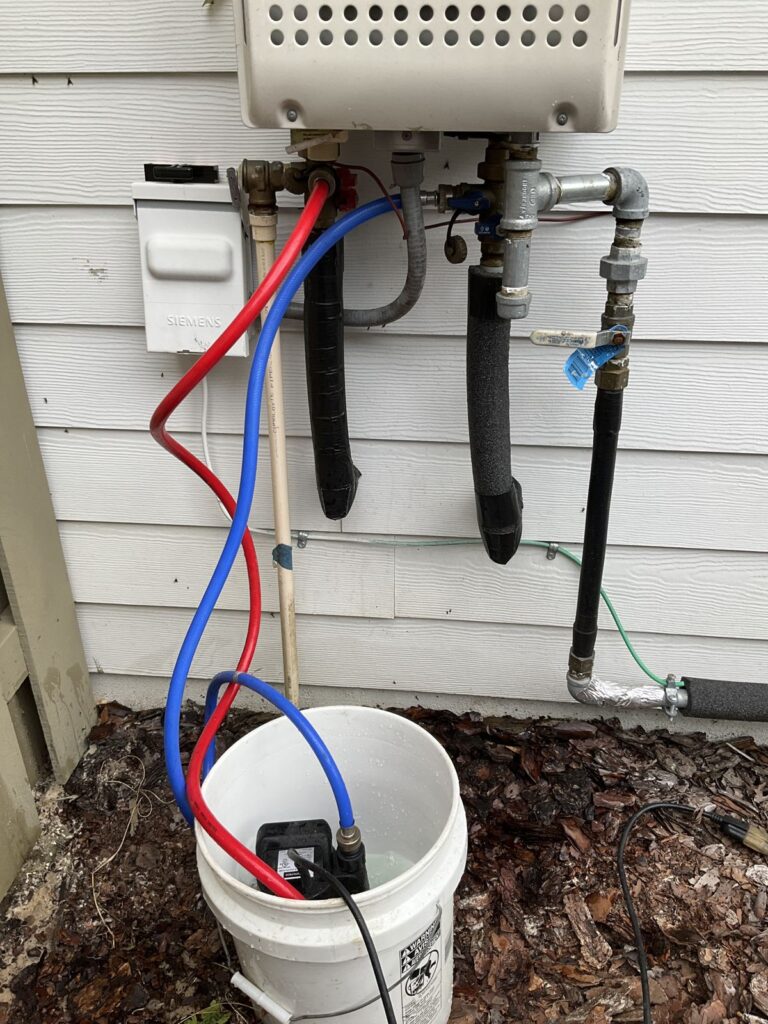
The unit will tell you before it quits. Watch for these:
- The temperature swings. The shower goes hot, then cool, then hot. Scale is fooling the sensors and slowing the flow at the same time.
- Hot water takes longer to show up at the same faucet it used to reach quickly.
- Flow drops on the hot side only. Cold pressure is fine, hot is weaker than it was. That is restriction inside the exchanger or a plugged inlet filter screen.
- You hear ticking, popping or crackling while it fires. That is water moving through and around deposits.
- Your gas or electric bill crept up without anybody taking longer showers.
- An error code shows up and clears itself. On Navien units, codes in the ignition and flame family often trace back to scale and restriction. On Rheem units, an overheat or flow related code does the same thing. Write the number down before you reset it. It saves us time and it saves you money.
- You cannot remember the last flush, or you bought the house and the unit came with it. That one counts.
None of these mean the unit is ruined. They mean it is asking for the service it was designed to get. Caught here, it is a flush. Ignored for another two years, it can turn into a heat exchanger, and that is the expensive end of this conversation.
- What it costs
What does a tankless water heater flush cost in Gainesville?
About $350 for a standard residential unit with working isolation valves. That is the whole visit described above, not just the vinegar.
For context, and these are national 2026 averages rather than our prices, a professional tankless flush commonly runs $150 to $350 depending on what is included. The low end of that range is usually a circulate and go. Ours includes the inlet screen, the condensate trap, the venting check, the gas pressure check and the written service record, and it is performed by a licensed plumber rather than a maintenance tech.
Two things that change the number: a unit with no isolation valves takes longer and needs valves added, and a commercial unit on a restaurant line is its own conversation. Commercial plumbing
If you would rather not think about it every year, the maintenance plan bundles the flush with the reminder and a few other things, and it spreads the cost out. Maintenance plan Larger work can go on financing through Wisetack from about $500 up. Financing
Thinking about a new unit instead? See Tankless Water Heaters in Gainesville, FL.
- About $350
- Standard residential unit with working isolation valves. The whole visit, not just the vinegar.
- Maintenance plan
- Bundles the flush with the reminder and a few other things, and spreads the cost out.
- Meet the owner
Who is going to be at your water heater?
First Choice Plumbing is locally owned and based out of Hawthorne. Will Harrod owns it and holds the Florida certified plumbing contractor license, CFC1430748. Kim answers the phone and dispatches, and Mike runs the service calls, so on a flush he is usually the one at your unit.
Maintenance work is where a lot of companies send their least experienced person, because nothing is broken. We do it the other way. A flush is the visit where somebody should notice the venting that has separated, the condensate line that is plugged, or the softener that quit doing its job two years ago. You only catch those if the person standing there knows what he is looking at.
- Will Harrod, owner. Holds the Florida certified plumbing contractor license, CFC1430748.
- Kim answers the phone and dispatches.
- Mike runs the service calls, so on a flush he is usually the one at your unit.
- How often, honestly
How often should you flush a tankless water heater here?
Once a year covers almost everybody in Alachua County. That matches what the manufacturers publish. Rheem calls for draining and descaling every six to twelve months. Navien says at least annually, more often depending on mineral content.
Now the part a lot of shops leave out. If you have a working water softener, once a year is plenty and you could reasonably stretch it. If you are on a hard private well with iron, twice a year is the honest answer and we will say so rather than watch you buy a heat exchanger in year six. And if you have a whole house filtration train that is actually maintained, we will tell you the unit looks clean and to see us next year.
We would rather book you once a year for a long time than sell you a service you do not need and lose you. Here is the quick read.
| Your water | How often to flush | Why |
|---|---|---|
| GRU city water, no softener | Once a year | About 8.2 grains per gallon of hardness. Steady scale, predictable pace. |
| City water with a working softener | Once a year, and it will look easy | Softened water leaves very little scale, but the inlet screen and venting still need eyes on them. |
| Private well, untreated | Twice a year | Hardness plus iron and sulfur out of the limestone. Deposits build faster and rougher. |
| Private well with treatment | Once a year | Treatment does the heavy lifting. We verify the treatment is still doing its job while we are there. |
| Restaurant, salon or laundry | Every three to six months | Volume, not water quality. A commercial unit runs a residential year in a few months. |
| Unit you inherited with the house | Now, then set the clock | Assume it has never been done, because it usually has not been. |
- What our tankless flush includes
What is included in a tankless flush?
A flush is not just running vinegar through a pipe. Here is the whole visit, start to finish.
1. We isolate the unit and hook to the service valves.
If your installer put isolation valves on it, this is quick. If they did not, we will tell you what it takes to add them, because without them nobody can service this unit properly, including you.
2. We circulate food grade white vinegar
through the heat exchanger with a pump for 45 to 60 minutes. No industrial descaling chemicals in a system that feeds your kitchen sink. Vinegar dissolves calcium just fine and it is safe going down the drain.
3. We flush it clean with fresh water
until nothing is coming back but water, then bleed the air out and restore normal operation.
4. We pull and clean the cold water inlet filter screen.
This is the step most people skip and it is often where the lost flow actually went.
5. We check the condensate trap and drain
on condensing units, because a plugged trap backs acidic condensate into places it should not be.
6. We look at the venting
for blockage, separation or nesting. That one is a safety check, not an upsell.
7. We verify gas pressure and confirm the unit fires clean,
then read out and clear any stored error codes.
8. We leave you a dated service record
with the unit model and serial on it. Keep it. If you ever file a warranty claim, that piece of paper is what proves the unit was maintained.
If we find something genuinely wrong while we are in there, you get told, with a price, before anything else happens. A flush visit does not turn into a repair without your yes. Water heater repair
No isolation valves on your unit? We can add them, and after that the annual service takes an hour instead of an afternoon.
- What to expect
What happens when you book a flush?
Tell us what you have.
Kim answers the phone and asks three things: the brand, whether it is gas or electric, and whether you are on city water or a well. If you are not sure, text a photo of the unit and the label. That call takes two minutes and it tells us what to bring.
We come out and do the whole service.
Vinegar through the exchanger, inlet screen cleaned, condensate trap and venting checked, gas pressure verified, codes read and cleared. Plan on about an hour for a unit with service valves.
You get the record and the reminder.
We leave a dated service record with the model and serial for your warranty file, tell you honestly when the next one is due based on your water, and we will reach out when it is time so you are not tracking it.
- The difference is in the details
The difference is in the details
| What you are comparing | First Choice Plumbing | Typical Plumbing Company or Big-Name Brand |
|---|---|---|
| Price | About $350, published on this page before you call | No number anywhere, or a low teaser that grows once the tech is at the unit |
| What is in the service | Flush plus inlet screen, condensate trap, venting, gas pressure and a written record | Circulate vinegar, reset the unit, leave |
| What we run through your heater | Food grade white vinegar, safe for the drain and the appliance | Whatever descaling chemical is on the truck |
| Who performs it | A licensed plumber, on a license the owner holds himself | A maintenance tech on a route, working from a checklist |
| Warranty paperwork | Dated service record with model and serial, left with you | An invoice that says "flush" |
| Advice on frequency | Based on your actual water, and we will tell you when once a year is plenty | A subscription cadence set by the sales plan |
| Rural and well addresses | Routed and scheduled like everybody else, because we live out there too | Trip charges, wide windows, or no coverage past the city line |
None of that is a knock on the big companies. It is just what a small, licensed, locally owned shop can do that a call center cannot.
- What a flush actually does
What does flushing a tankless water heater actually do?
A tankless unit does not store hot water. It heats it on the way past, inside a narrow copper or stainless heat exchanger, and it does that fast. To pull that off, the burner has to run very hot against thin walls with a small amount of water moving through them.
That is where the trouble starts. Calcium and magnesium come out of solution when water gets hot, and they stick to the inside of that heat exchanger as a hard, chalky crust. Scale is an insulator. Once it coats the walls, the burner has to fire longer and hotter to deliver the same shower, and the water passages get narrower at the same time.
Three things follow, in this order, over a couple of years:
- You pay more for the same hot water. The unit runs longer per gallon. You do not notice it because it happens a little at a time.
- The temperature starts wandering. Hot, then cool, then hot again, usually worst at a low flow like a bathroom sink.
- The unit starts protecting itself. Flow sensors and high limit switches see restriction and heat, and you get an error code on the display that clears when you reset it, then comes back.
A flush reverses the first two and usually prevents the third. We circulate food grade white vinegar through the heat exchanger for 45 to 60 minutes, and the acid dissolves the scale and carries it out. Nothing is taken apart. Nothing is replaced. The unit goes back to moving heat the way it was designed to.
Is Gainesville water hard enough to scale a tankless heater?
Yes, and the number is public. Gainesville Regional Utilities draws from the Floridan Aquifer and treats it at the Murphree plant. The finished water runs moderately hard, roughly 140 mg/L as calcium carbonate, which works out to about 8.2 grains per gallon. That is good water to drink. It is also enough hardness that manufacturers put you squarely in the annual flush column rather than the every-other-year column.
Out in the county it is a different story again. If you are on a private well around Hawthorne, Melrose, Windsor, Micanopy or northern Marion County, you are pulling straight out of porous limestone, and along with hardness you get iron and hydrogen sulfide. Iron leaves its own deposits and it is rougher on a heat exchanger than calcium alone. Private wells are not regulated either, so nobody is testing yours unless you do.
Here is the honest tradeoff. You can flush a heater once a year forever, which is the cheap route and it works. Or you can treat the water and stop making scale in the first place, which costs more up front and protects every fixture, every appliance and your skin along with the heater. Neither one is wrong. It depends on what else the water is doing to your house.
Softeners and filtration here: Water softeners | Well water filtration
Not ready to book anything? Ask us to test your water for free while we are out. Water testing
- Warranty, DIY and next steps
Does skipping the flush really void the warranty?
It can, and this is the part worth reading twice. Every major tankless manufacturer writes periodic descaling into the maintenance terms of the warranty. Scale damage is treated as neglect, not as a defect. When a heat exchanger fails on a unit with no service history, the claim is a hard one to win, and the homeowner usually finds that out on the worst possible day.
That is why we leave a dated record with the model and serial on it. It costs us nothing and it is the thing that answers the manufacturer’s first question.
The money side is simple too. A flush is a one hour visit. A replacement heat exchanger on a modern condensing unit is a large part plus a couple of hours of labor, and on an older unit the smarter money often goes toward a whole new heater instead. A tankless unit that gets serviced should run 15 to 20 years. One that never gets touched in hard water can start acting up before year eight.
You are not choosing between spending money and not spending money. You are choosing when, and how much.
Can I flush my tankless water heater myself?
If your unit has isolation valves with service ports, yes, and plenty of people do. You need a small submersible pump, two hoses, a five gallon bucket and about four gallons of white vinegar. Shut off the gas or power, close the isolation valves, hook the pump to the cold service port and the return hose to the hot one, circulate for 45 to 60 minutes, then flush with clean water and clean the inlet screen. That is the honest recipe and we are not going to pretend it is a secret.
Here is where people get into trouble. Doing it with the gas on. Using a hardware store descaler instead of vinegar and damaging a component the warranty then will not cover. Forgetting the inlet filter screen, which is where half the lost flow lives. Not restoring the valve positions and running the unit dry. And skipping the venting and condensate checks entirely, because a homeowner has no reason to know to look.
If you want to do it yourself, do it. If you would rather have a licensed plumber do it, sign off on the venting and gas, and hand you the record your warranty may need, that is what the $350 buys.
Not sure whether your unit even has service valves? Text us a photo of it at 352-377-9447 and we will tell you.
Get it flushed, get the paperwork, and forget about it for a year.
Tell us the brand and whether you are on city water or a well. We will come out, do the full service for about $350, hand you the dated record your warranty may need, and tell you honestly when the next one is due. If your water is treated and the unit comes back clean, we will tell you that too. Book Your Tankless Flush Online
Licensed CFC1430748. Food grade vinegar, no harsh chemicals. Service record left with you. Leaks don’t stand a chance.
- Frequently asked questions
Frequently asked questions
Once a year for most homes on GRU water, which runs about 8.2 grains per gallon of hardness. Rheem calls for descaling every six to twelve months and Navien says at least annually, more often with higher mineral content. On an untreated private well with iron, twice a year is the honest answer. With a working softener, once a year is plenty.
Scale builds inside the heat exchanger and acts like insulation. The unit burns more fuel for the same hot water, the temperature starts swinging, flow drops on the hot side, and eventually error codes show up and stop clearing. Left long enough in hard water it can take out the heat exchanger, which is the most expensive part in the unit.
About $350 for a standard residential unit with isolation valves, and that covers the full service: vinegar circulation, inlet filter screen, condensate trap, venting check, gas pressure check and a dated service record. National 2026 averages run $150 to $350 depending on how much of that is actually included.
It can. Every major manufacturer writes periodic descaling into the maintenance terms, and scale damage is treated as neglect rather than a defect. Without a service history it is a hard claim to win. That is why we leave a dated record with the model and serial on it, so you have the paperwork if you ever need it.
If it has isolation valves with service ports, yes. You need a small pump, two hoses, a bucket and about four gallons of white vinegar, circulated for 45 to 60 minutes and then flushed with clean water. Shut the gas or power off first, use vinegar rather than a hardware store descaler, and do not forget the inlet filter screen.
No. We circulate food grade white vinegar. It dissolves calcium properly, it is safe for the appliance and safe going down the drain, and it will not put your warranty at risk the way some industrial descalers can. It is the same thing the manufacturers describe in their own maintenance guidance.
About an hour for a residential unit with service valves, since the vinegar needs 45 to 60 minutes to circulate before the clean water flush and the rest of the checks. If the unit has no isolation valves, plan on longer, and we will talk to you about adding them so future service is quick.
Yes, but it gets easier. Softened water leaves very little scale, so an annual visit is plenty and the flush itself comes back clean. The visit is still worth it for the inlet screen, the condensate trap, the venting check and the service record, and it is when we can tell you whether the softener is still doing its job.
8.2
Grains per gallon of hardness in GRU water, which is why annual flushing is the standard here
1 a Year
Flushes most Alachua County homes need, matching the manufacturer maintenance terms
15 to 20
Years a maintained tankless unit should run, against under ten when scale is left alone
CFC1430748
Florida certified plumbing contractor license, held by the owner
- Where we work
Where do you go for tankless service?
We are based in Hawthorne, so we cover Gainesville and all of Alachua County, plus Melrose, Interlachen, Keystone Heights, Micanopy, Waldo, Windsor, Archer, Newberry, High Springs, Alachua and Williston, and out into Putnam, Bradford, Union, Levy, Clay and northern Marion counties.
Kim batches the schedule by area, so annual maintenance out in the county gets a real appointment window instead of a wide guess. If you are on a well past the county line, you are exactly who this service is for, and you are not a hassle to us. That is our own neighborhood.
7counties served
22towns with local pages
Hawthornehome base
- Service county
- Town page
- Home base
Select any county or town to open its page.
Don’t see your town? We likely still come out — call 352-377-9447
- Leaks don't stand a chance.
Tell us what's going on and we'll take it from there
You get a real person, a $69 visit, a flat price before we start, and a company that patches what it cuts and answers the phone when you call back. If a smaller fix is the right call, we’ll tell you that too.

First Choice Plumbing is a locally owned, owner led plumbing company working Gainesville, Hawthorne and Greater Alachua County. Leak detection, repipes, water heaters, drains, trenchless lining, well water filtration and septic. We find it, we fix it, we guarantee it.
Florida Certified Plumbing Contractor CFC1430748
Explore
Services
-
First Choice Plumbing
6940 SE 221st St
Hawthorne, FL 32640 - Office Mon to Fri, 8 to 5. Emergency line 24/7.
Copyright © 2026 First Choice Plumbing Inc. All rights reserved. FL Certified Plumbing Contractor CFC1430748.
Proudly Building Legacy with Legacy Sales Engineering